



All solar panels generate only direct current (DC). However, most household appliances operate on alternating current (AC). Therefore, an inverter must always be installed between solar panels and household electrical devices. Without it, neither a solar power system nor a backup power system can supply real electrical loads. Below, we will cover the fundamentals of inverter operation and selection.
What Is an Inverter?
An inverter is an electronic device that converts direct current (DC) into alternating current (AC) with specified parameters: 220 V or 380 V voltage and a frequency of 50 Hz. These are the characteristics required for the operation of household appliances, boilers, pumps, and standard industrial equipment.
In systems based on solar panels, the inverter is the central component. It receives power from panels or batteries, converts it into the required form, and manages the entire system. More advanced models can charge batteries, transmit data to a mobile application, and automatically switch between power sources.
Why Is an Inverter Needed in Renewable Energy Systems?
The role of an inverter is not limited to current conversion. Depending on the type of system, it performs different tasks:
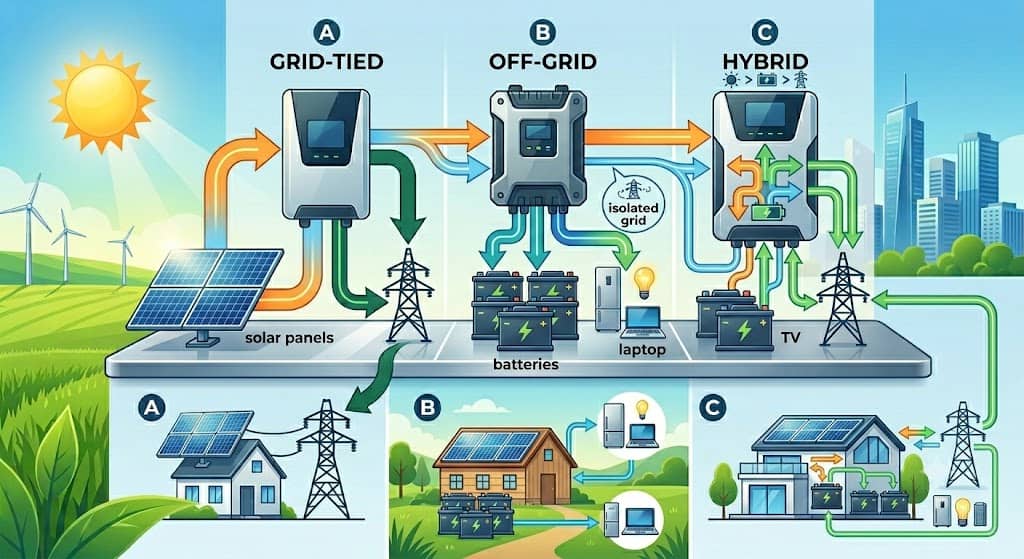
- In a grid-tied solar power system. The inverter converts DC power from the panels into AC power, synchronizes it with grid parameters, and supplies it to the building’s electrical wiring. Excess energy is automatically exported to the grid, forming the basis of net metering or feed-in tariff programs. In the event of a grid outage, the inverter shuts down in accordance with safety regulations.
- In a hybrid system. A hybrid inverter manages three power sources simultaneously: solar panels, batteries, and the utility grid. During a power outage, it switches to battery power within 10–20 ms without interrupting the connected loads.
- In an off-grid system. It operates exclusively with solar panels and battery banks, without any grid connection. It generates a stable 220 V AC output for electrical loads and controls battery charging through a built-in MPPT charge controller.
These are the primary functions that help prevent various issues with electrical equipment.
How Does an Inverter Work?
The DC-to-AC conversion process is based on high-speed electronic switching. Power transistors (MOSFETs or IGBTs) alternately switch the current on and off tens of thousands of times per second. After passing through an LC filter, a smooth 50 Hz sine wave is produced. Output signal quality is critically important. There are two main types:
- Pure sine wave – an accurate reproduction of the sinusoidal voltage waveform identical to the utility grid. It is essential for motor-driven loads such as pumps, boilers, refrigerators, and compressors. All Altek inverters produce a pure sine wave output.
- Modified sine wave – a stepped approximation of a sine wave. It is less expensive to produce but is not suitable for sensitive electronics and may damage electric motors over time.
The built-in MPPT controller (Maximum Power Point Tracking) continuously identifies the operating point at which solar panels deliver maximum power. This increases energy production by 20–30% compared to outdated PWM controllers, especially under changing cloud conditions.
What Types of Inverters Are Available?
Inverters are divided into three main types according to their connection principle and power sources. The choice determines both the system’s operating scheme and its financial model.
Grid-Tied Inverters (Grid-Tie)
These operate only when connected to the utility grid. Excess energy production is exported to the grid, enabling revenue through net metering or feed-in tariff programs. They offer high efficiency of up to 98.6%. Since batteries are not required, the overall system cost is reduced. Altek’s ACRUX and Asterion series are available in capacities from 2 to 30 kW.
Off-Grid Inverters (Off-Grid)
These operate independently of the utility grid, using only solar panels and batteries. They combine an MPPT charge controller and battery charger in a single enclosure. They are ideal for locations without centralized electricity supply. Altek’s Atlas series offers power ratings from 2.7 to 8 kW.
Hybrid Inverters (Hybrid)
These combine the capabilities of both grid-tied and off-grid devices. They work simultaneously with solar panels, batteries, and the utility grid, automatically switching between operating modes. During a power outage, they instantly take over the load without interrupting the power supply.
Advantages and Features of Inverters
A modern inverter is much more than a simple power converter. Here are the features that distinguish high-quality models from low-cost alternatives:
- Efficiency of up to 98.6% for grid-tied models and 95–97% for hybrid models. The difference between 92% and 97% efficiency in a 10 kW system can exceed 600 kWh of energy losses per year.
- Operating temperature range from –20°C to +60°C. The inverter can function reliably in an unheated boiler room during winter and under a hot roof in summer.
- Multi-level protection against overheating, overload, short circuits, overvoltage, and deep battery discharge.
- Parallel operation capability. Multiple inverters can be connected together to increase total system capacity without replacing existing equipment.
Choosing the right inverter is one of the most important decisions when designing a solar power system. Incorrect power sizing or battery compatibility can lead to significant operating costs. Altek specialists provide free system sizing and consultation.


Your email address will not be published. All fields are required