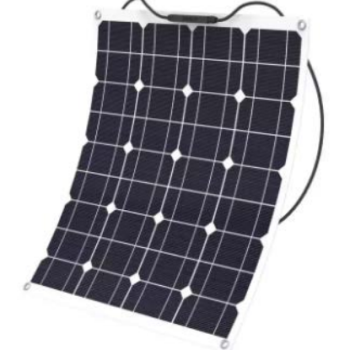


Flexible Solar Panels
A flexible solar panel weighs just 2–4 kg, can bend up to 30°, and mounts to any surface in a matter of minutes without the need for metal mounting profiles. Where a conventional module simply won’t fit physically—such as the curved roof of a camper, a yacht deck, or an arched canopy—this panel gets the job done. The Altek catalog features flexible modules with capacities up to 200 W.
Flexible Solar Panels: Features and Purpose
A standard solar panel consists of 20+ kg of glass and an aluminum frame, requiring a heavy load-bearing structure. A flexible solar panel is engineered differently: monocrystalline cells are encapsulated in ETFE or PET polymer instead of glass. This results in a thickness of just a few millimeters, a weight of 2–4 kg, and the ability to bend without cracking.
Pro Tip: An ETFE substrate is highly preferable to PET. It is UV-resistant and won’t yellow after a few seasons under the open sky. Always check the substrate type in the technical datasheet. While PET is cheaper, it begins to lose transparency after 5–7 years of intense UV exposure, which degrades energy output.
How Flexible Solar Panels Work
The generation principle is exactly the same as that of rigid panels: photons displace electrons within the silicon cells, creating a direct current (DC). The output features standard MC4 connectors, making them fully compatible with any MPPT controller or inverter without requiring adapters.
Built-in bypass diodes provide protection against partial shading: if a portion of the panel is shaded, the remaining cells continue to operate. However, when flush-mounted without a ventilation gap, the cells run hotter, which reduces efficiency and lifespan. Whenever possible, leave a clearance of at least 1–2 cm.
Advantages of Flexible Solar Panels
Why choose flexible solar panels?
- Ultra-lightweight (2–4 kg): Can be installed where standard modules would overload the structure.
- Aerodynamic & curved mounting: Installs seamlessly on contoured surfaces without support profiles or anchors.
- No metal frame: Zero risk of corrosion in marine environments.
- Fast installation: Easily secured using adhesive, heavy-duty double-sided tape, or rivets.
- Scattered light performance: They remain active even in cloudy weather and diffuse light conditions.
Note: With an efficiency of 14–18% and a lifespan of up to 15 years, these specs are notably lower than those of rigid panels. Flexible modules are not suitable for stationary residential rooftop solar power plants; their niche is strictly mobile and non-standard applications.
Applications of Flexible Photomodules
In practice, flexible photomodules are indispensable in several scenarios:
- Yachts, boats, and cutters: Perfect for curved decks and harsh marine environments.
- Campers and RVs: Ideal for rounded roofs where keeping weight to a minimum is critical.
- Military use: Excellent for setting up mobile charging stations.
- Architectural roofs: Fits complex, non-standard structural shapes.
- Urban canopies and awnings: Great where a rigid module would disrupt the architectural design.
They are not used in residential grid-tied solar systems; conventional high-efficiency monocrystalline models remain the best choice for that purpose.
Buy Flexible Solar Panels: Pricing and Selection at Altek
In the Altek.ua catalog, you can buy flexible solar panels backed by an official warranty. We always provide up-to-date pricing and precise technical specifications.
We ensure rapid shipping from our warehouses in Kyiv, Lviv, and Dnipro across all of Ukraine. If you need expert advice on selecting the right capacity or mounting type, simply request a callback via the form on our website.
Showing all 2 results