


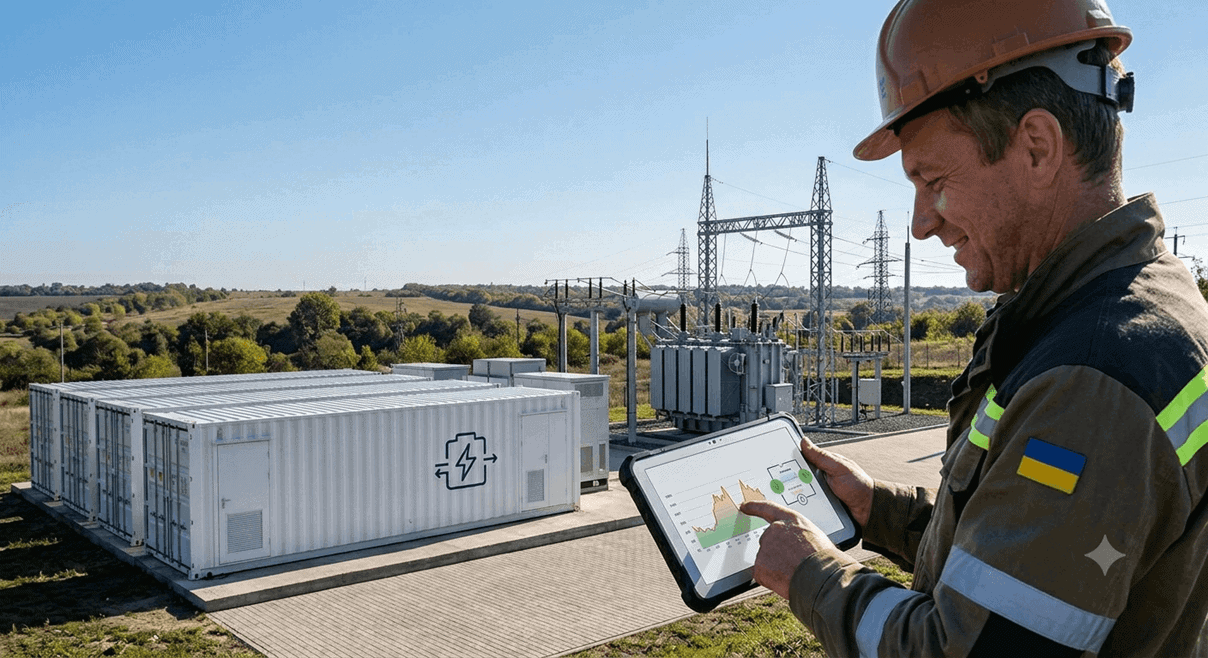
Electricity arbitrage is a business model in which an energy storage system (ESS) is charged cheaply during periods of low demand and then supplies power to a facility during peak hours, when the grid tariff is at its highest. The difference in price, minus operating costs, becomes profit. Let’s examine how this works in Ukraine today.
What Is Electricity Arbitrage?
The price of electricity is not constant throughout the day. On the day-ahead market (DAM), it depends on the balance between supply and demand. At night, prices fall, while during morning and evening peak hours they rise sharply.
For residential consumers with a dual-zone meter, the difference is already significant: the night tariff is UAH 2.16/kWh (23:00–07:00), while the daytime tariff is UAH 4.32/kWh (07:00–23:00), a 2:1 ratio. An energy storage system charges at night at the lower tariff and discharges during the day, replacing electricity that would otherwise be purchased at the full price. This is the simplest form of arbitrage for a private household and is usually designed for one main cycle per day. A second economically viable charging cycle is possible if the household has its own solar PV system or another low-cost energy source.
For industrial consumers, the spread between peak and off-peak prices on the wholesale market can reach 5–10 times. Commercial ESS installations ranging from hundreds of kilowatts to several megawatts are used in this segment.
How Energy Storage Systems (ESS) Work
An ESS (Battery Energy Storage System, BESS) consists of a battery bank, a bidirectional inverter, and an EMS (Energy Management System). The arbitrage cycle works as follows:
- Charging. At night (23:00–07:00), the system automatically charges the battery bank from the grid at the lowest tariff. The EMS analyzes price forecasts for the next day and determines the optimal charging schedule.
- First discharge. In the morning (07:00–10:00), the first price peak occurs. The ESS switches to discharge mode, and the facility is powered by the batteries instead of expensive grid electricity.
- Second charge. Around midday, when solar PV generation is high and market prices decrease, the system recharges or tops up its battery.
- Second discharge. In the evening (17:00–22:00), the second peak period begins. The batteries discharge again, offsetting expensive electricity consumption.
LiFePO4 batteries can withstand 6,000–10,000 cycles, which theoretically corresponds to 16–27 years with one cycle per day or 8–14 years with two cycles per day.
How Profit Is Generated in Electricity Arbitrage
Several revenue streams can be combined.
Savings on Self-Consumption
A business avoids purchasing electricity during peak hours and instead uses energy stored at night. The tariff difference becomes direct savings. A 500 kWh ESS operating two cycles per day with a UAH 2/kWh spread has a theoretical savings potential of about UAH 730,000 per year, excluding efficiency losses, battery degradation, and operating expenses.
Providing Frequency Regulation Services (Balancing)
Ukrenergo purchases frequency regulation services from ESS owners. Because storage systems respond almost instantly (within milliseconds), they are ideal for primary and secondary frequency control. The owner receives a fixed availability payment even if the service is not activated.
Trading on the Day-Ahead Market
Large operators with ESS capacity of 1 MWh or more can participate directly in the DAM. They buy electricity when prices are low during surplus periods and sell when prices are high during shortages. Ukraine’s electricity market is highly volatile, and a 5–10x difference between night and peak prices is not uncommon.
What Requirements Apply in Ukraine for ESS Operation
Requirements depend on system capacity, connection scheme, and operating mode. For self-consumption without exporting stored energy to the grid, a separate license may not be required. For electricity trading or the provision of ancillary services, the operator must obtain the appropriate market participant status, implement commercial metering, sign agreements with the grid operator, and ensure technical compliance of the equipment.
Who Can Benefit from Electricity Arbitrage?
The model can be scaled from a household to a large industrial facility:
- Households with a dual-zone meter. A 10–30 kWh ESS charges at night at UAH 2.16/kWh and powers the home during the day instead of buying electricity at UAH 4.32/kWh. In a hybrid setup with solar panels, payback is typically 5–8 years.
- Small and medium-sized businesses. A 100–500 kWh ESS covers morning and evening demand peaks. When combined with solar PV, daytime charging can be essentially free. Payback is usually 3–5 years.
- Industrial facilities. ESS installations of 1 MWh and above can combine arbitrage with balancing market participation. Payback is often 2–4 years.
How to Calculate the Payback of an Energy Storage System
Basic formula: Annual savings = number of cycles × [capacity × efficiency × peak price − capacity × charging price].
Example: a 200 kWh ESS, 600 cycles per year, a UAH 2.16/kWh spread (difference between daytime and night tariffs), and 88% round-trip efficiency:
600 × [200 × 0.88 × 4.32 − 200 × 2.16] = UAH 196,992/year.
The cost of a commercial ESS depends on capacity, manufacturer, and exchange rates. Payback must be calculated individually; participation in balancing services can significantly shorten the payback period compared with pure arbitrage.
When calculating, consider battery degradation (~2% capacity loss per year), maintenance costs (1–2% of system cost annually), and future tariff changes. If you need assistance preparing a feasibility study, Altek specialists are ready to help.


Your email address will not be published. All fields are required