



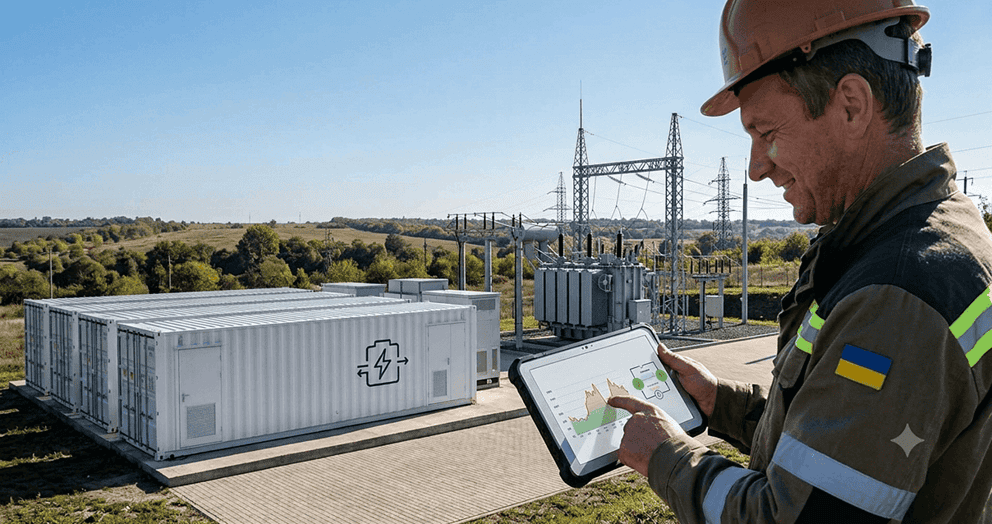
An Energy Storage System (ESS, or BESS) is a set of equipment that stores electricity and supplies it to consumers when needed. A typical system includes battery modules, a bidirectional inverter, automation equipment, and an energy management system. For businesses, an ESS can serve as a backup power source, a load management tool, and a complement to an on-site solar power plant.
What Is an ESS and How Do Energy Storage Systems Work?
During charging, electricity from the grid or a solar power plant is supplied to the battery system. When the facility’s load increases, external power is interrupted, or a predefined operating period begins, the system supplies the stored energy to consumers.
Automatic control is handled by the EMS (Energy Management System). It monitors the state of charge, current power, and consumption profile, determining the optimal time for charging and discharging. As a result, the ESS operates according to a predefined algorithm without requiring constant staff involvement.
Why Do Businesses Need Energy Storage Systems?
At a commercial or industrial facility, an energy storage system can address several tasks at once:
- provides backup power for critical loads during grid outages;
- reduces peak demand;
- shifts energy consumption between different periods of the day;
- stores surplus on-site solar generation;
- supports the operation of essential equipment during power disruptions.
For a retail store, this may include powering cash registers and refrigeration equipment. For a manufacturing facility, it can support selected production lines. For a business with a solar power plant, an ESS can increase the share of solar energy consumed on-site.
How Can an ESS Reduce Electricity Costs?
One of the main applications is peak shaving, which means reducing peak demand. When electricity consumption increases sharply, part of the required power is supplied by the batteries. This smooths the load profile and reduces the amount of electricity drawn from the grid during periods of peak demand.
Another option is energy arbitrage. The ESS charges during periods when electricity is cheaper, and the stored energy is used when electricity prices are higher. When combined with a solar power plant, the battery stores excess daytime solar generation for use in the evening.
How to Choose an ESS for a Business
The two main parameters are power, measured in kW, and energy capacity, measured in kWh. Power indicates how much load the system can support simultaneously, while capacity determines how much energy can be stored. When selecting an ESS, the following factors should be considered:
- hourly electricity consumption profile;
- maximum and average load;
- solar power plant capacity;
- required backup duration;
- battery efficiency and allowable depth of discharge;
- potential growth in electricity consumption.
For example, a 50 kW load operating for two hours requires 100 kWh of usable energy. The nominal battery capacity should be higher because system losses and the allowable depth of discharge must be taken into account.
Payback and Efficiency of an Energy Storage System
The payback period of an ESS depends on equipment costs, the number of charge-discharge cycles, charging costs, savings from solar generation, peak demand reduction, and operating expenses. The cost of preventing downtime should also be considered separately. For a manufacturing facility, server room, or refrigeration system, even a short power outage can cost more than a portion of the electricity savings.
For an accurate calculation, the facility’s actual hourly consumption profile should be analyzed rather than relying solely on monthly electricity consumption. Altek specialists can determine the appropriate power and battery capacity and develop an ESS operating strategy based on the facility’s load profile, on-site generation, and required level of energy autonomy.

Your email address will not be published. All fields are required