


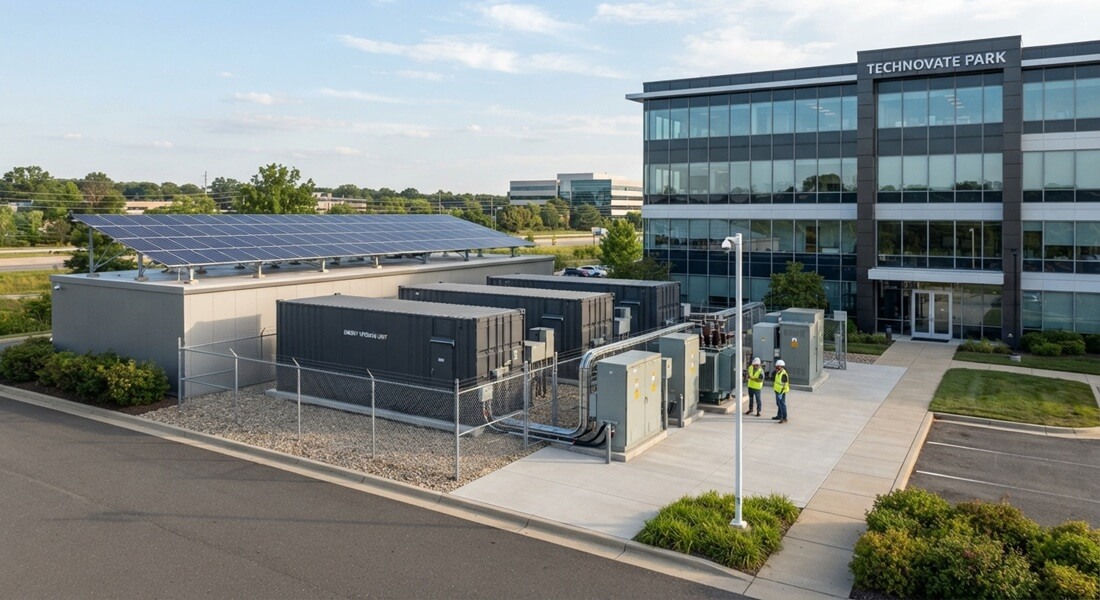
For a business, a BESS is much more than just a backup battery. A Battery Energy Storage System (BESS) can reduce peak demand, shift electricity consumption between different times of the day, store surplus solar generation, and keep critical equipment running during power outages.
What Is a BESS and Why Does a Business Need an Energy Storage System?
A typical BESS includes battery modules, a battery management system, a power conversion system, automation equipment, and an energy management system. In industrial solutions, these components are often integrated into a ready-made cabinet or container.
Two characteristics are particularly important for businesses: power capacity, measured in kW, and energy capacity, measured in kWh. The first determines how much load the system can supply or absorb at a given moment, while the second determines how much energy is available over time. Therefore, a 100 kW/200 kWh BESS can deliver 100 kW for approximately two hours only under idealized calculation conditions. Actual operating time depends on the permitted depth of discharge, efficiency, and operating mode.
How to Calculate the Required BESS Power and Capacity
Power capacity is selected according to the intended application. For backup power, the key reference is the combined power demand of critical loads. For peak shaving, it is the amount by which the maximum load needs to be reduced.
The capacity required for backup power can be preliminarily calculated using the following formula:
BESS capacity = load × operating time / (efficiency × permitted depth of discharge).
For example, a business needs to maintain a 60 kW load for 2 hours. The consumers require 120 kWh. With an efficiency of 95% and a permitted depth of discharge of 90%, the calculation is:
120 / (0.95 × 0.90) ≈ 140 kWh.
This is an estimated nominal capacity. In an actual project, an additional reserve is provided to account for gradual battery degradation and possible increases in load.
How Businesses Can Use a BESS to Reduce Electricity Costs
The first scenario is peak shaving. If a facility typically consumes 150 kW but its load temporarily rises to 230 kW, a BESS can cover part of the difference and make the consumption profile more consistent.
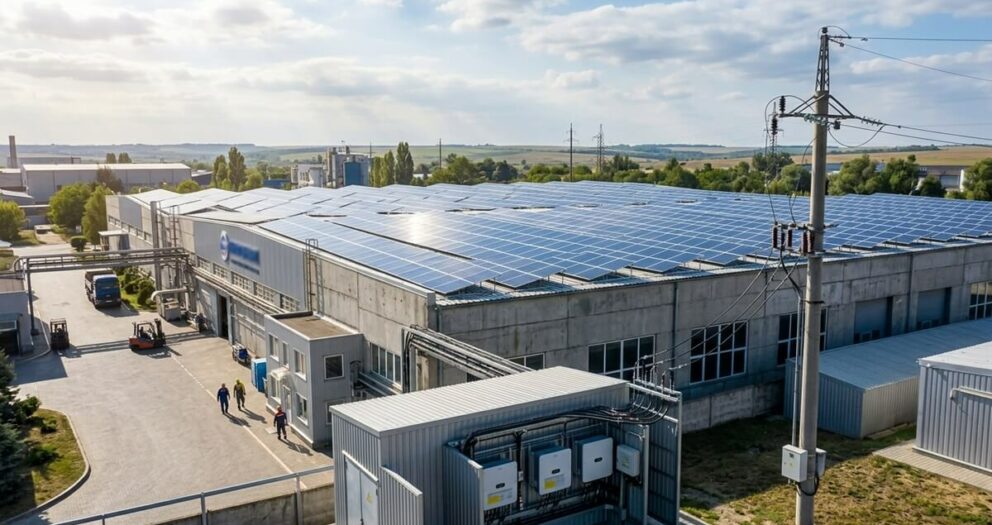
The second scenario is shifting energy consumption over time. The system charges during an economically favorable period or from the facility’s own solar power system (SPS), and discharges when using the stored energy provides greater benefits. When combined with an SPS, an energy storage system also reduces the amount of daytime surplus that the business cannot consume itself.
The third source of value is avoided downtime. For a manufacturing facility, refrigerated warehouse, or server infrastructure, the cost of even a single outage can exceed the savings achieved through differences in electricity prices.
How to Calculate the Payback Period of an Energy Storage System
First, calculate the annual financial benefit:
Annual benefit = savings from peak shaving + benefits from shifting energy consumption + increased self-consumption of solar generation + losses avoided due to power outages − operating expenses.
Then calculate the simple payback period:
Payback period = investment in the BESS / annual net benefit.
For example, if the system, including installation, costs UAH 3 million and the verified net benefit amounts to UAH 750,000 per year, the simple payback period is 4 years. This is an illustrative example: an actual project should be based on real hourly load data, actual electricity purchase prices, the number of battery cycles, and projected battery degradation.
How to Choose a BESS for a Business: Key Technical Parameters
Before placing an order, check the following:
- nominal and peak power;
- usable and nominal energy capacity;
- permitted depth of discharge;
- round-trip efficiency;
- expected cycle life;
- charging and discharging rates;
- battery chemistry;
- integration capabilities with a solar power system, generator, and facility management system.
For a commercial project, a calculation based on the monthly electricity bill is not sufficient. At least an hourly load profile is required: it shows the duration of peak loads, the amount of energy consumption that can potentially be shifted, and the required kW-to-kWh ratio.
The Altek catalog features industrial BESS solutions, making it possible to select a configuration based on the specific needs of a business rather than simply the system’s total energy capacity.



Your email address will not be published. All fields are required