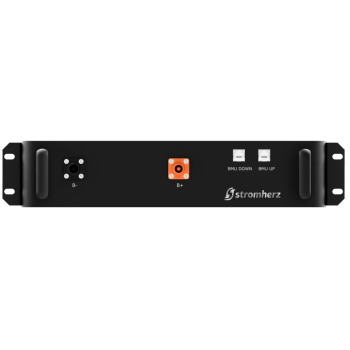


A LiFePO4 battery retains its charge for thousands of cycles, does not overheat when recharged, and weighs half as much as a lead-acid battery of the same capacity. This is precisely why it is chosen for domestic solar power systems, backup power supplies and electric vehicles. The Altek.ua catalogue features modules for 12, 24 and 48 V systems, with a warranty and delivery from Kyiv, Lviv or Dnipro.
LiFePO4 batteries for domestic use and solar power stations
Lithium iron phosphate batteries have nothing in common with old lead-acid batteries, apart from their intended use. The lithium iron phosphate cathode provides a chemically stable structure that does not degrade during deep discharge and does not catch fire when overheated. This is a fundamental difference from cheaper NMC batteries.
The Altek catalogue features LiFePO4 batteries in 12 V / 24 V / 48 V formats – ranging from compact 50 Ah modules to rack-mounted batteries for serious backup systems.
Lithium iron phosphate batteries: advantages
Lifespan is the key selling point. A LiFePO4 battery can withstand 2,000–6,000 full charge cycles, depending on the model and depth of discharge. Under the same conditions, an AGM battery degrades after 400–600 cycles. With a daily charge/discharge cycle, a lithium-phosphate battery will last 8–15 years without needing replacement.
A depth of discharge of up to 80% does not damage the cells – for lead-acid batteries, the safe threshold is half that. This means that, for the same nominal capacity, a LiFePO4 battery actually delivers one and a half times more energy.
Safety. LiFePO4 chemistry is thermally stable: in the event of mechanical damage or a short circuit, the cells do not catch fire or explode, unlike NMC and NCA.
Weight. Lithium iron phosphate batteries are 2–3 times lighter than lead-acid batteries with the same capacity. This is crucial for installation in a boiler room or technical cabinet, as reinforced shelving is not required.
The built-in BMS monitors each cell and disconnects the battery in the event of overheating, overcharging or a short circuit. Most models transmit status data to the inverter via CAN or RS485, allowing the inverter to monitor charge level, temperature and current in real time and manage charging more accurately than without a connection to the battery.
LiFePO4 batteries for solar systems
In a hybrid solar power system, the LiFePO4 battery stores excess kilowatts during the day and releases them in the evening. This reduces the load on the grid during peak hours and means you don’t need to purchase any electricity at all during the night.
High discharge current is another practical advantage. A 1 kW pump at 48 V requires a starting current of up to 80 A. Most lithium-phosphate batteries deliver this peak current without a voltage drop, whereas AGM batteries lose a significant amount of voltage at such currents.
Compatibility with Altek inverters is seamless: Atlas and hybrid models support the BMS communication protocol, display the battery status in the app and automatically regulate the charging current depending on the temperature. Where LiFePO4 batteries are used:
- a domestic solar power system with battery-powered night-time supply;
- backup power for a boiler room, server or medical equipment;
- an off-grid system at a holiday home without a centralised grid;
- a property with high evening peak-time electricity rates.
The capacity of the battery bank can be easily scaled up: modules can be connected in parallel without replacing the inverter. For example, starting with 5 kWh and adding another 5 kWh a year later is a perfectly feasible approach to expanding the system in stages.
How do you choose a lithium iron phosphate battery?
The first parameter is capacity. Formula: daily consumption in kWh × required runtime in hours ÷ 24 ÷ 0.8 (allowable discharge rate). A house with a night-time consumption of 4 kWh requires a battery bank of approximately 5 kWh.
Voltage. Systems with a capacity of 3 kW or more are configured at 48 V, which reduces currents and cable cross-sections. Ensure that the battery voltage matches the input range of your inverter.
Peak discharge current. Consider the inrush currents of the most powerful loads – the pump, compressor, boiler. The battery’s peak current must be higher, with a margin.
Temperature range. The standard charging range for LiFePO4 is from 0°C to +45°C. If the battery is located in an unheated room, you need a model with a cell heating system; otherwise, charging will be blocked by the BMS in winter.
Communication protocol with the inverter. The BMS must ‘speak’ the same language as the inverter: CAN, RS485 or Modbus. If the protocols do not match, no data will be transmitted, and the inverter will be unable to control the charging current.
Buy a LiFePO4 battery at a great price from Altek
At Altek.ua, you can purchase a lithium iron phosphate battery with an official warranty, delivered throughout Ukraine from our warehouses in Kyiv and Dnipro. Our service includes:
- Selection of battery capacity and compatibility checks with your inverter – free of charge;
- Delivery from our warehouses in Kyiv and Dnipro – no waiting;
- Up-to-date prices for LiFePO4 in our catalogue with no hidden mark-ups;
- After-sales technical support.
Choose a lithium phosphate battery from the catalogue or contact a sales representative, who will select the right option for your system.
Bestsellers in Lithium iron phosphate batteries






Showing 1–12 of 14 results